15 Unique Holi Photoshoot Ideas: How to Capture Perfect Festive Photos
Holi gives photographers a subject that almost no other event provides: pure, explosive color in motion against human emotion. But capturing that well requires specific techniques — the right shutter speed, the right angle, the right light, the right moment. This guide breaks down 15 actionable Holi photoshoot ideas with the exact settings and execution steps needed to make each one work, whether you are using a DSLR, mirrorless, or smartphone.
Enhance Your Holi Photos with AI Tools
Color boost, background cleanup, resolution upscaling — no signup required.
Explore All AI Photo ToolsTable of Contents
- Quick Summary
- The Challenge of Holi Photography
- Step-by-Step: Outdoor Holi Photoshoot Ideas
- Step-by-Step: Creative Holi Portrait Ideas
- Step-by-Step: Group Holi Photoshoot Ideas
- Step-by-Step: Indoor Holi Photoshoot Ideas
- Step-by-Step: Creative Concept Ideas
- Practical Example: Full Shoot Walkthrough
- Equipment Protection Tips
- Enhancing Holi Photos with AI Tools
- Professional Tips
- Common Mistakes to Avoid
- The Future of Holi Photography
- Frequently Asked Questions
Quick Summary
The single most important variable in Holi photography is shutter speed. To freeze powder mid-air, use 1/1000s or faster. Everything else — composition, background, lighting — builds on top of that. For golden hour outdoor shots, shoot backlit with the sun low and behind the subject. For indoor controlled shoots, use side or back lighting to illuminate the powder particles floating in air. Protect your camera before you enter any powder-throwing environment, not after. And post-process with AI color enhancement to recover vibrancy that even well-exposed RAW files compress slightly.
The Challenge of Holi Photography
Holi creates three specific photographic challenges that do not exist in standard portrait or event photography. First, the subject is moving fast and throwing powder — requiring high shutter speeds that demand enough ambient light or a wide aperture to compensate. Second, colored powder shifts white balance and can muddy skin tones in post-processing if not shot in RAW. Third, the chaotic environment makes it easy to get technically decent but compositionally weak shots — a cloud of orange powder with no clear subject, or a face so covered in color that expression is unreadable.
The 15 ideas below are organized around solving these three problems: freezing motion, managing light, and building intentional composition into each shot before you press the shutter.
Step-by-Step: Outdoor Holi Photoshoot Ideas
Natural light and open space create the ideal conditions for high-energy Holi shots. These four ideas exploit outdoor environments for maximum visual impact.

1. Color Powder Explosion
Setup: Position your subject against a clear sky background — blue sky creates the cleanest color contrast. Have them hold a fistful of powder in each hand.
Camera settings: Shutter speed 1/1000s minimum, aperture f/2.8–f/4, ISO adjusted to maintain exposure. Use burst mode to capture the arc of the throw across multiple frames.
Execution: Count down and have the subject throw the powder upward and outward at the same moment you begin your burst. Shoot during golden hour — low-angle sunlight makes the powder particles catch light and glow rather than appearing as flat, opaque clouds.
Composition: Keep the subject's face in focus and the powder cloud extending into the upper frame. Leave headroom above the subject for the powder trajectory.
Clean Up Photobombers and Distractions
Remove unwanted background elements from your powder explosion shots without disturbing the powder cloud or subject.
Try AI Cleanup Tool2. Action Shots with Water Balloons
Setup: Fill balloons with colored water. Position the subject at arm's length and have a second person throw the balloon at the subject on your countdown. This gives you one controlled split-second to capture.
Camera settings: Shutter speed 1/2000s or faster to freeze water droplets in mid-air. High-speed burst mode. Position yourself at a safe distance — at least 3 meters — to protect the lens from water impact.
Execution: Pre-focus on the spot where the balloon will burst. Use continuous autofocus. Capture the frame at the exact moment of balloon impact, not after — the first millisecond of burst produces the most dynamic splash geometry.

3. Golden Hour Backlit Portraits
Setup: Schedule this shot 30–45 minutes before sunset. Position the subject with the sun directly behind them. You are exposing for the subject's face, not the background — the background will be slightly overexposed, creating a rim-light halo effect.
Camera settings: Aperture f/1.8–f/2.8 for subject separation. Use exposure compensation (+1 to +1.5 EV) to expose the face correctly against the bright backlit sky. Shutter speed 1/1000s to freeze powder thrown above the subject's head.
Execution: Have the subject gently toss powder above their head. The low-angle backlight will catch the fine particles and make them glow orange-gold. This is the most visually distinctive outdoor Holi technique when executed correctly.

4. Aerial Perspective
Setup: Identify an elevated position — balcony, rooftop, or drone — before the celebration begins. Scout the angle at ground level first to anticipate where color concentrations will appear.
Camera settings: Wide-angle lens (24–35mm equivalent) to capture the full scene. Aperture f/5.6–f/8 for deep depth of field across the entire crowd. Shutter speed 1/800s to freeze motion at distance.
Execution: Shoot during peak activity — coordinated group throws create the densest color formations. For drone shots, fly at 10–20 meters to capture individual faces while still showing the scale of the crowd. Obtain required permissions before flying a drone in a public celebration.
Step-by-Step: Creative Holi Portrait Ideas
Portraits at Holi isolate individual expression from the collective chaos. The goal is to balance color-covered faces with readable emotion.

5. Colorful Close-Up Portraits
Setup: Use a 50mm or 85mm portrait lens. Step close enough to fill the frame with the subject's face and upper chest. Find a location with a clean, uncluttered background — a plain wall, open sky, or foliage at distance.
Camera settings: Aperture f/1.8–f/2.0 to isolate the subject from the background. Focus precisely on the eyes — color-covered faces with sharp eyes create the strongest emotional connection. Use exposure lock to prevent the camera from overexposing the brightly colored face against a darker background.
Execution: Ask the subject to hold their gaze directly into the lens. Do not ask them to smile — natural, neutral expressions reveal more interesting emotion in color-saturated close-ups. Take multiple frames to capture micro-expressions.
Enhance Portraits with AI
Balance color saturation across the face while preserving natural skin tone gradients in post-processing.
Try AI Portrait Enhancer6. Hands Full of Colors
Setup: Fill the subject's upturned palms with contrasting powder colors — red and yellow, blue and orange. Position the camera directly above the hands for a top-down shot, or level at hand height for a horizontal composition.
Camera settings: Macro lens or close-focus setting. Aperture f/4–f/5.6 for enough depth of field to keep both hands sharp. Natural diffused light or soft fill flash for shadow detail in the powder texture.
Execution: Capture both static compositions (palms still, showing powder detail) and action frames (subject blowing or releasing the powder). The transition between these two states produces the most dynamic single frames.

7. Contrast Portraits Against Dark Backgrounds
Setup: Find a shadowed wall or dark indoor surface as background. Outdoors, position the subject in front of a shaded area while keeping them in direct or diffused light. For studio work, use a black seamless backdrop.
Camera settings: Single side-light or rim-light positioned at 45 degrees to the subject. Aperture f/2–f/2.8. Expose for the subject's face — the dark background will underexpose naturally without any special treatment.
Execution: Have the subject throw a handful of powder toward or across the camera axis. The powder cloud will appear dramatically lit against the dark background, creating a three-dimensional effect unavailable against bright backgrounds.
Step-by-Step: Group Holi Photoshoot Ideas
Group shots document the collective dimension of Holi — the interaction, the scale, the shared joy. These two approaches give you both the coordinated and the candid side of that.

8. Synchronized Color Throw
Setup: Arrange 6–12 people in a circle or semicircle, each holding a different powder color. The variety of colors in a single coordinated throw produces the most visually complex single frame possible in Holi photography.
Camera settings: Wide-angle lens (16–24mm) to include the full group and the overhead powder cloud. Aperture f/5.6 for adequate depth of field across the group. Shutter speed 1/1000s. Continuous burst mode.
Execution: Brief the group on the countdown. Begin your burst 0.5 seconds before the planned throw moment — the anticipatory body language frames that precede the throw are often stronger than the throw itself. Position yourself low (crouching) to shoot upward toward the powder cloud against sky.
Expand Group Shots That Cropped Someone Out
AI Expand extends your image canvas to include people cut off by tight framing — without distorting the original image.
Try AI Expand9. Candid Interaction Shots
Setup: Use a 70–200mm zoom lens to shoot from outside the active celebration zone. This distance gives you optically compressed compositions that feel intimate while keeping the camera safe from powder and water.
Camera settings: Continuous autofocus tracking on the primary subject. Shutter speed 1/800s or faster for spontaneous movement. Aperture f/4 for enough depth to keep two or three people sharp in the same frame during interactions.
Execution: Move around the perimeter and observe before shooting. Identify recurring interaction patterns — the moment someone reaches to apply color to a friend's face, the reaction of surprise, the shared laughter afterward. These three-beat sequences consistently produce the strongest candid frames.

Step-by-Step: Indoor Holi Photoshoot Ideas
Indoor shoots trade spontaneity for control. You direct the light, the background, the timing, and the powder quantity — producing results that are often more technically refined than outdoor celebration shots.
10. Controlled Backlighting with Powder
Setup: Place a single continuous light source (LED panel or strobe with diffusion) directly behind the subject, at head height. The camera should be positioned facing the subject with the light behind them — the same geometric relationship as golden hour outdoor shooting, but controllable at any time of day.
Camera settings: Expose for the subject's face using spot metering. Aperture f/2–f/2.8. Shutter speed 1/500s–1/1000s to freeze powder. Use a lens hood to prevent backlight from washing out contrast in the lens.
Execution: Have the subject hold powder in front of their chest and release it upward. The backlight will catch the fine particles and create a three-dimensional glow effect. Shoot multiple throws — the first often produces the densest cloud; subsequent throws add trailing wisps that can be equally interesting.

11. Intentional Background Selection
Setup: Choose background color based on which Holi powder colors will dominate the shot. White backgrounds amplify color vibrancy across the full spectrum. Black backgrounds create maximum contrast and drama. Complementary-colored backgrounds (blue behind orange powder, purple behind yellow) create color harmony. Contrasting backgrounds create visual tension — effective for editorial-style shots.
Execution: Test the background choice with a single powder throw before committing. What looks right in your mental composition may not work with the actual powder color in that light. Adjust background or powder color before the full session.
Generate Custom AI Backgrounds
Create any background color, texture, or scene to pair with your Holi portraits without physical setup.
Generate Custom Backgrounds12. UV Reactive Colors Under Blacklight
Setup: Source UV-reactive Holi powder (available from specialty suppliers). Darken the room completely. Install UV/blacklight LED strips or panels at 45-degree angles to the subject to maximize glow uniformity without creating visible light spill into the camera lens.
Camera settings: High ISO (3200–6400) in a dark environment. Aperture f/1.8–f/2.8. Shutter speed 1/500s–1/800s to balance the slower ambient UV light with the need to freeze powder movement. Shoot RAW to control noise in post-processing.
Execution: This setup produces results unavailable anywhere else in Holi photography — neon colors against black, floating particles that appear to emit their own light. The visual grammar is entirely different from daylight Holi shots and performs well for digital content where differentiation matters.

Step-by-Step: Creative Concept Holi Photoshoot Ideas
These three ideas require more deliberate art direction but produce the strongest portfolio and editorial work.
13. Holi Color Silhouettes
Setup: Position the subject between the camera and a bright background — direct sunlight, a studio strobe at maximum output, or a large window. Expose for the bright background. The subject will go dark, creating a silhouette.
Camera settings: Spot meter on the bright background. Shutter speed 1/1000s. Aperture f/5.6–f/8 to keep the entire powder cloud sharp around the silhouette edge. Shoot in burst mode across the full arc of the powder throw.
Execution: The silhouette reduces the subject to pure shape and gesture, which forces compositional strength. Body language becomes the entire visual language of the image — choose poses that are expressive and readable as pure outlines. Arms extended, head thrown back, and mid-jump positions read most clearly as silhouettes.

14. Intentional Motion Blur
Setup: This technique reverses the standard approach — instead of freezing motion, you record it as blur. Use a tripod to keep the background sharp while the subject and powder record as motion streaks.
Camera settings: Slow shutter speed of 1/15s–1/60s. Aperture f/8–f/11 to compensate for the longer exposure. ISO 100–200 to minimize noise at slow shutter speeds. Tripod is non-negotiable — any camera shake will destroy the background sharpness that makes the motion blur visible.
Execution: Have the subject move continuously through a dance motion or powder throw during the entire exposure. The result is a painterly abstraction of color and movement that reads more as expressive art than documentary photography — appropriate for fine art prints, editorial features, and high-concept social content.
Upscale Motion Blur Shots for Print
AI Image Upscaler recovers detail and sharpens edges in creative motion blur shots without destroying the intentional blur effect.
Upscale Your Images15. Holi Face as Art — Intentional Color Application
Setup: Apply Holi colors in deliberate geometric or abstract patterns rather than random application. Use brushes for precision, or stencils for repeatable patterns. Document the art direction process, not just the finished result.
Camera settings: Standard portrait settings — 85mm, f/2.0, natural diffused light or large softbox. Focus precisely on the eyes or the most intricate color pattern on the face.
Execution: This concept positions Holi face photography within the tradition of body art and face painting. The intentionality distinguishes these images from celebration snapshots. Shoot both close-up detail frames and full-face compositions to give the series visual range.

Practical Example: Full Shoot Walkthrough
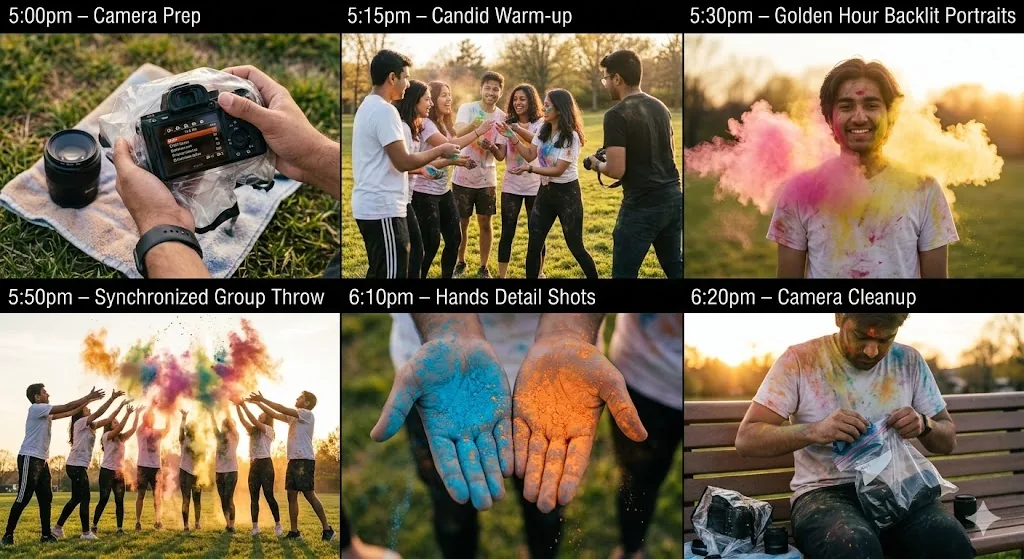
Scenario: A 2-hour outdoor Holi shoot with a group of six friends, one mirrorless camera (Sony A7 III), 50mm and 85mm lenses, golden hour starting at 5:30pm.
5:00pm — Camera prep: Mount UV filter on both lenses. Wrap camera body in rain cover. Set both lenses to RAW capture, auto ISO (800–6400), continuous autofocus, burst mode 10fps.
5:15pm — Candid warm-up (Idea 9): Move around the group with the 50mm while they apply colors to each other informally. No direction — pure observation. Capture 80–100 frames to get 5–10 keepers of genuine interaction.
5:30pm — Golden hour backlit portraits (Idea 3): Position individuals against the low sun with the 85mm. Spot meter each subject's face. Direct single powder throw per person. 10 throws produces 2–3 excellent frames per subject.
5:50pm — Synchronized group throw (Idea 8): Arrange group in a semicircle. Brief them on countdown. Shoot low, wide, upward. 3 coordinated throws at peak golden hour light. Select the frame where color distribution is most spatially even across the group.
6:10pm — Hands detail shots (Idea 6): Switch back to 50mm. Direct two subjects to load palms with contrasting colors. Top-down and horizontal compositions. Both static and release/blow frames.
6:20pm — Camera cleanup: Seal camera in bag before returning indoors. Do not open any ports or change lenses until the camera has been wiped down externally.
Protecting Your Camera During Holi Photography
Colored powder is fine-particulate and migrates into every gap in a camera body over time. Water damage from balloons and water guns is immediate. Neither type of damage is covered under standard manufacturer warranties, and both are preventable.
Essential Protection Steps
- Use a weather-sealed camera body where available — but weather sealing does not mean powder-proof. Always add a physical cover.
- Cover non-sealed cameras with a clear plastic bag, cutting a hole only for the lens port. Secure the bag around the lens barrel with a rubber band.
- Apply a UV filter to every lens in use — it is the only thing standing between powder and your front lens element.
- Never change lenses in an active powder environment. Sensor contamination from powder ingestion during lens changes is permanent without professional cleaning.
- Keep lens caps on every lens not currently mounted.
- After the shoot, wipe down the entire exterior before opening any ports, card slots, or battery doors.
- If powder enters a body port or lens barrel, do not blow it out with compressed air — this drives particles deeper. Use a soft brush and bring the equipment to a camera technician.

Rescue Photos from Difficult Shooting Conditions
If equipment issues or unexpected light conditions affected your shots, AI enhancement tools can recover color accuracy and detail.
Enhance with AI FiltersEnhancing Your Holi Photos with AI Tools
Even technically well-executed Holi photos benefit from post-processing. Color powder shifts white balance, high-speed shooting at elevated ISO introduces grain, and cluttered celebration environments create background distractions. These three AI tools address each issue directly.
Color Enhancement
Holi powder color shifts under different light conditions — the same red powder looks orange in golden hour and flat magenta under overcast sky. The AI Filter tool boosts saturation and adjusts color balance across the image while preserving natural skin tone gradients that get damaged by manual saturation sliders.

Background Replacement
Celebration environments are visually noisy. Power lines, parked vehicles, and crowd members entering the frame behind the subject are nearly impossible to avoid entirely. The AI Background Replace tool removes cluttered backgrounds and replaces them with clean alternatives — without disturbing the powder cloud or subject edges.

Resolution Enhancement
High-speed bursts at 1/1000s or faster require elevated ISO in many lighting conditions, which introduces noise at the pixel level. AI Image Upscaler reconstructs fine detail — individual powder particle edges, skin texture, hair strands — without introducing the sharpening halos that standard Lightroom clarity adjustments produce.

Full AI Editing Suite for Holi Photography
Color, cleanup, upscaling, background replacement — all tools available in one place, no signup required.
Explore All AI ToolsProfessional Tips for Better Holi Photography
Shoot RAW, not JPEG. JPEG compression compounds across Holi's extreme color gradients and produces visible banding in post-processing when you push saturation. RAW preserves the full tonal range and gives you accurate color channel data to work with in editing.
Use spot metering, not evaluative. Evaluative metering on a colorful scene tries to average the entire frame and produces inconsistent exposures across a burst sequence. Spot meter on the subject's face or the most important tonal area and lock exposure before shooting.
Bring two camera bodies if possible. The moment you stop to change lenses is the moment the best frame happens. Mounting a wide-angle on one body and a portrait lens on the other eliminates lens changes entirely for the duration of the celebration.
Position before the throw, not during it. Pre-compose your frame, pre-focus, and pre-set your exposure before instructing the subject to throw powder. Adjusting position after the powder is in the air means you miss the peak moment every time.
Calibrate white balance to powder color in post, not in-camera. Holi shoots involve simultaneous red, blue, green, yellow, and pink powder — there is no single correct in-camera white balance for all of them. Shoot in daylight WB and correct per-image in post using RAW files.
Common Mistakes to Avoid
Using shutter speeds below 1/500s for powder action shots. Powder moves faster than it looks. Anything below 1/500s produces motion blur in the cloud, which obscures the color separation that makes Holi powder shots distinctive. Use 1/1000s as your minimum and 1/2000s for water balloon impacts.
Shooting at midday sun. Overhead noon light creates harsh downward shadows under eyebrows, noses, and chins that make color-covered faces look muddy and unreadable. Schedule outdoor portrait work during golden hour and use midday time for equipment setup and scouting.
Not briefing subjects before the shoot. Subjects who do not know the countdown, the direction to throw, or where to look produce inconsistent results that require more takes. 60 seconds of briefing per subject consistently produces better results than 10 spontaneous attempts.
Ignoring the background until post-processing. A strong Holi portrait shot against a distracting background is a weak Holi portrait. Background selection takes 30 seconds before the shot and saves 20 minutes of AI editing after it. Develop the habit of evaluating the background before every setup.
Oversaturating in post-processing. Holi photos already contain extreme color. Pushing saturation further in editing produces neon-looking skin tones and unnatural color relationships. Adjust color balance and individual hue channels selectively rather than pulling the global saturation slider.
The Future of Holi Photography
AI is changing post-production for Holi photography faster than it is changing capture technique. The core physical challenges — shutter speed, light management, equipment protection — remain constant. What is changing is how much of the post-processing workflow can be automated.
In 2026, AI color enhancement, background replacement, and resolution upscaling are all web-based and accessible without Photoshop or Lightroom. By 2026–2027, expect AI tools to handle automatic powder color enhancement on a per-particle basis, separating the physics of the powder cloud from the human subject and allowing independent color grading of each. Generative AI background replacement is already producing context-aware results that match the lighting of the original scene — this will become standard in free-tier tools within 12–18 months.
For content creators, the increasing accessibility of AI post-processing tools means the competitive advantage is shifting back to capture — to being in the right position at the right moment with the right settings. Technical post-processing is being commoditized. Creative and photographic judgment is not.
Frequently Asked Questions
What camera settings work best for Holi photography?
Use 1/1000s shutter speed minimum for powder shots — 1/2000s for water balloon impacts. Aperture f/1.8–f/2.8 for portraits, f/5.6–f/8 for group shots. Burst mode for all action sequences. Shoot RAW for accurate color recovery in post-processing.
How can I enhance my Holi photos with AI tools?
Use AI Filter tools for color saturation and balance adjustments that preserve skin tone. Use AI Cleanup or Background Replace for removing distracting background elements. Use AI Image Upscaler to recover fine detail from high-ISO burst shots. All three address specific, common Holi photography post-processing problems and are available at no cost through Modern Photo Tools.
What time of day is best for outdoor Holi photography?
Golden hour — 30 to 60 minutes after sunrise or before sunset — produces the best outdoor Holi images. Low-angle warm light makes powder particles glow and eliminates the harsh downward shadows that midday overhead sun creates on color-covered faces. Schedule portrait work during golden hour and use other daylight hours for candid and group documentation.
How do I protect my camera during Holi photography?
Cover the camera body in a clear plastic bag or dedicated rain cover before entering the celebration environment. Apply a UV filter to every lens in use. Never change lenses outdoors during the celebration. After shooting, wipe down the exterior before opening any ports or battery doors. Do not blow powder out of ports with compressed air — this forces particles deeper into the mechanism.
Can I shoot creative Holi photos indoors?
Indoor Holi photography offers full control over light direction, background, and timing that outdoor celebration shooting cannot provide. Backlit setups reveal powder cloud depth. Black backgrounds maximize color contrast. UV-reactive colors under blacklight produce results unavailable in natural light. Indoor environments also protect the camera from the full powder saturation of outdoor celebrations.