Nano Banana 2 Explained: Google's Fastest AI Image Generation Model
Nano Banana 2 launched on February 26, 2026 - less than six months after the original Nano Banana went viral and generated over 5 billion images. This guide breaks down what the model actually is, how the underlying technology works, and the specific ways content creators and designers can use it in real workflows today.
Quick Definition
Nano Banana 2 (technically named Gemini 3.1 Flash Image) is Google's latest AI image generation and editing model. It combines the Pro-level quality of Nano Banana Pro with the speed of Gemini Flash - making advanced image generation accessible to all users, not just paid subscribers.
It is the third model in the Nano Banana series: the original Nano Banana launched in August 2025, Nano Banana Pro followed in November 2025, and Nano Banana 2 became the new default across all Google products on February 26, 2026.
For content creators and designers, the practical meaning is this: you now get 4K output, precise text rendering, character consistency across multiple images, and real-time web knowledge - all at Flash speed, at no cost on the standard Gemini tier.
How the Technology Works
Understanding what makes Nano Banana 2 different requires understanding the three-layer architecture it is built on. It is not simply a "better" version of the previous model - it combines three distinct technical systems that previous versions kept separate.
Layer 1
Gemini Flash Foundation
The model is built on Gemini 3.1 Flash - Google's faster, lighter inference architecture. Flash models are optimized for speed without the full computational cost of Pro models. This is what makes real-time editing and rapid iteration possible. Previous generation Nano Banana Pro was built on Gemini 3 Pro, which was higher quality but significantly slower.
Layer 2
Real-Time Web Grounding
Unlike most image generation models that work purely from training data, Nano Banana 2 integrates real-time information from Google Search. When you ask it to generate a specific person, landmark, product, or brand, it can pull current visual reference from the web rather than relying solely on what was in the training set. This is what enables accurate rendering of specific real-world subjects.
Layer 3
Configurable Reasoning
Nano Banana 2 introduces configurable thinking levels - a control that lets the model reason through complex prompts before rendering. At Minimal (default), the model renders immediately. At High or Dynamic, it spends additional computation analyzing the prompt for nuance and constraint before generating. This is why it follows complex, multi-layered instructions more accurately than previous versions.
How a Single Generation Request Works
When you submit a prompt to Nano Banana 2, this is the sequence of operations that produces your output:
- Prompt parsing: The model reads and decomposes your text prompt, identifying subjects, style constraints, spatial relationships, lighting conditions, and output requirements (aspect ratio, resolution).
- Knowledge grounding: If the prompt references specific real-world subjects (a named person, a brand, a real location), the model queries Google Search in real time to retrieve relevant visual reference data.
- Reasoning pass (if enabled): At High or Dynamic thinking levels, the model runs an internal reasoning pass - effectively re-reading the prompt to identify constraints that a fast parse might miss before committing to a visual direction.
- Image synthesis: The model generates the image at your specified resolution, from 512px up to 4K, at any of the supported aspect ratios including the new ultra-wide formats (4:1, 1:4, 8:1, 1:8).
- SynthID watermarking: Every generated image receives an invisible SynthID digital watermark, now combined with C2PA Content Credentials - an interoperable standard used by Meta, Adobe, OpenAI, and others - providing verifiable provenance data embedded in the file.
Key Features for Creators and Designers
Precision Text Rendering
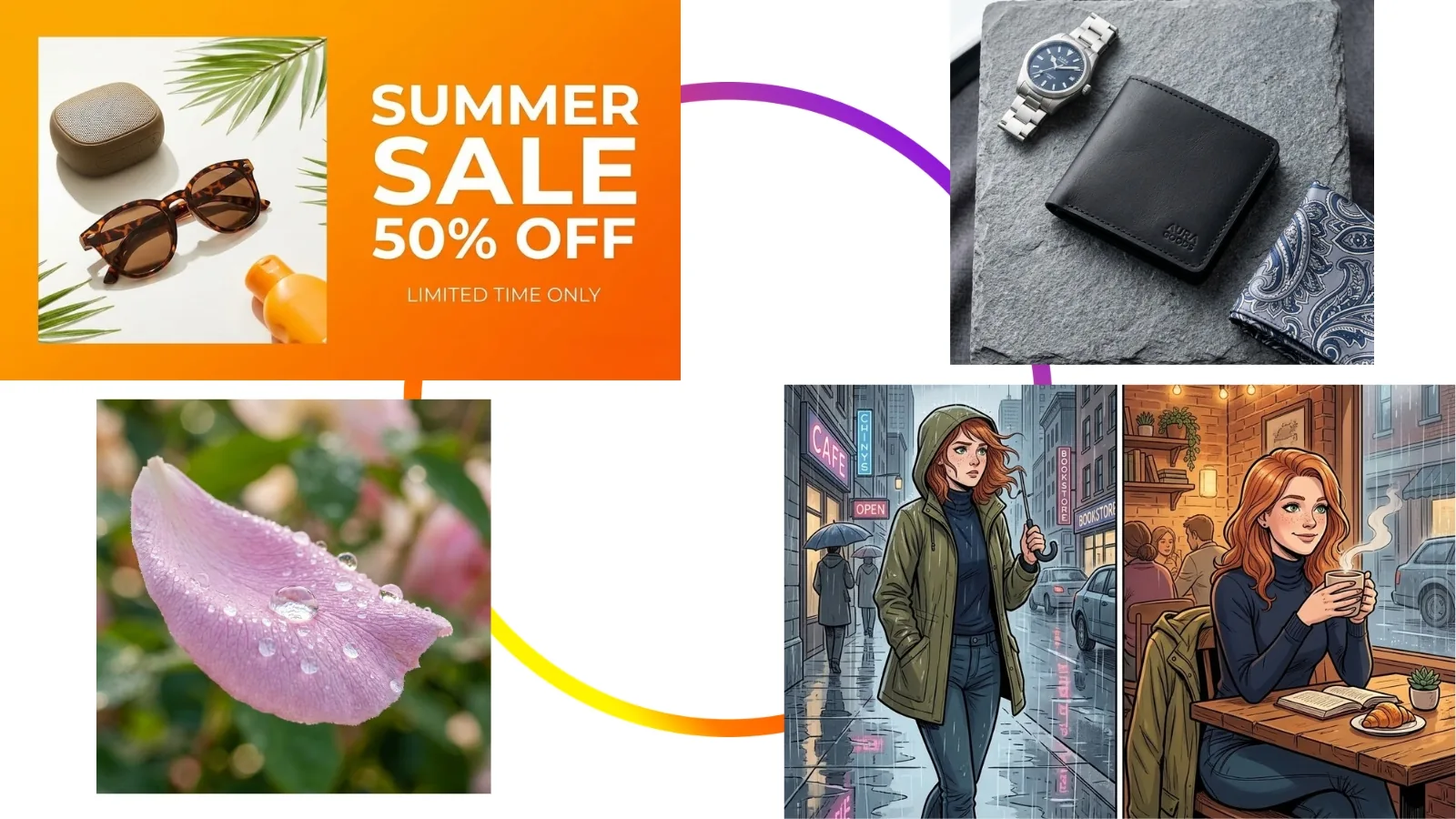
Nano Banana 2 generates accurate, legible text within images - including marketing mockups, greeting cards, posters, and banners. It also supports in-image text translation and localization across multiple languages, enabling international content production from a single source image.
Character Consistency
Maintains visual identity for up to 5 characters across multiple generated images in a single workflow. For designers building consistent characters for comics, brand mascots, storyboards, or social media series, this removes the need for manual reference-matching between generations.
Object Fidelity (Up to 14 Objects)
Preserves the visual fidelity of up to 14 distinct objects from input images when compositing complex scenes. Relevant for product flat lays, multi-object compositions, and intricate scene designs where each element needs to remain recognizable.
4K Resolution Output
Generates images from 512px up to 4K resolution in a single request. The previous Nano Banana was capped at 2K. 4K output meets print production standards for most commercial applications without additional upscaling.
Extended Aspect Ratios
Supports all standard aspect ratios plus new ultra-wide formats: 4:1, 1:4, 8:1, and 1:8. Relevant for panoramic social banners, vertical story formats, billboard mockups, and timeline covers that fall outside standard square and portrait crops.
Real-Time Knowledge
Pulls live information from Google Search during generation, not just training data. This enables accurate rendering of current events, specific real-world locations, recent products, and public figures without relying on training data that may be outdated.
Vibrant Lighting and Texture
Improved rendering engine produces more vibrant lighting, richer material textures, and sharper fine detail compared to both Nano Banana and Nano Banana Pro. Product photography, fabric textures, reflective surfaces, and studio lighting conditions are all more faithfully rendered.
SynthID + C2PA Watermarking
Every generated image carries an invisible SynthID watermark plus C2PA Content Credentials - the same standard used by Adobe, Meta, and OpenAI. Any viewer with a compatible tool can verify whether an image was AI-generated and trace its origin. Important for commercial use and editorial transparency.
Flash-Speed Iteration
Built on Gemini Flash, the model generates and edits images significantly faster than Nano Banana Pro. For workflows that require rapid iteration - client review cycles, A/B testing variations, campaign versioning - the speed difference changes the practical pace of work.
Nano Banana 2 vs. Nano Banana Pro: Which to Use
Google maintains both models simultaneously. The choice is not which is "better" - they are optimized for different priorities. Google's own positioning: Nano Banana Pro for "high-fidelity tasks requiring maximum factual accuracy"; Nano Banana 2 for "rapid generation, precise instruction following, and integrated image-search grounding."
| Dimension | Nano Banana 2 | Nano Banana Pro |
|---|---|---|
| Underlying model | Gemini 3.1 Flash Image | Gemini 3 Pro Image |
| Speed | Flash - significantly faster | Slower - higher compute cost |
| Maximum resolution | 512px - 4K | Up to 2K (previous cap) |
| Real-time web grounding | Yes - live search integration | No - training data only |
| Instruction following | Improved - multi-layer prompt parsing | Standard |
| Factual accuracy for known subjects | High (grounded by web) | Highest (Pro reasoning) |
| Character consistency | Up to 5 characters | Up to 5 characters |
| Object fidelity | Up to 14 objects | Up to 14 objects |
| Extended aspect ratios | Yes - includes 4:1, 8:1, 1:4, 1:8 | Standard ratios only |
| In-image text translation | Yes | No |
| Access | All Gemini users (free default) | Google AI Pro and Ultra only |
| Best for | Rapid iteration, social content, marketing, current-event imagery | High-stakes factual rendering, archival-quality output, tasks where speed is secondary |
Where It Is Available
Nano Banana 2 is rolling out as the default image generation model across Google's core product suite simultaneously with its announcement - not as a staged beta.
Gemini App
Default across Fast, Thinking, and Pro models. Select "Create images" from the tools menu. Available on iOS, Android, and web.
Google Search
Default in AI Mode and Google Lens. Available via the Google app and desktop/mobile browsers across 141 countries in 8 additional languages.
Google AI Studio
Available in preview via the Gemini API. Developers can access it with a paid API key. Configurable thinking levels and all advanced parameters are exposed here.
Gemini API + CLI
Available for programmatic access at production scale. Pricing is published in Google AI Studio. Also available on Vertex API for enterprise deployment.
Flow (Video Tool)
Nano Banana 2 is the new default image generation model inside Google's AI-powered video editing tool, Flow.
Google Ads + Antigravity
Available in Google's ad creative tools and the Antigravity platform for commercial image production at scale.
Practical Use Cases with Prompt Examples
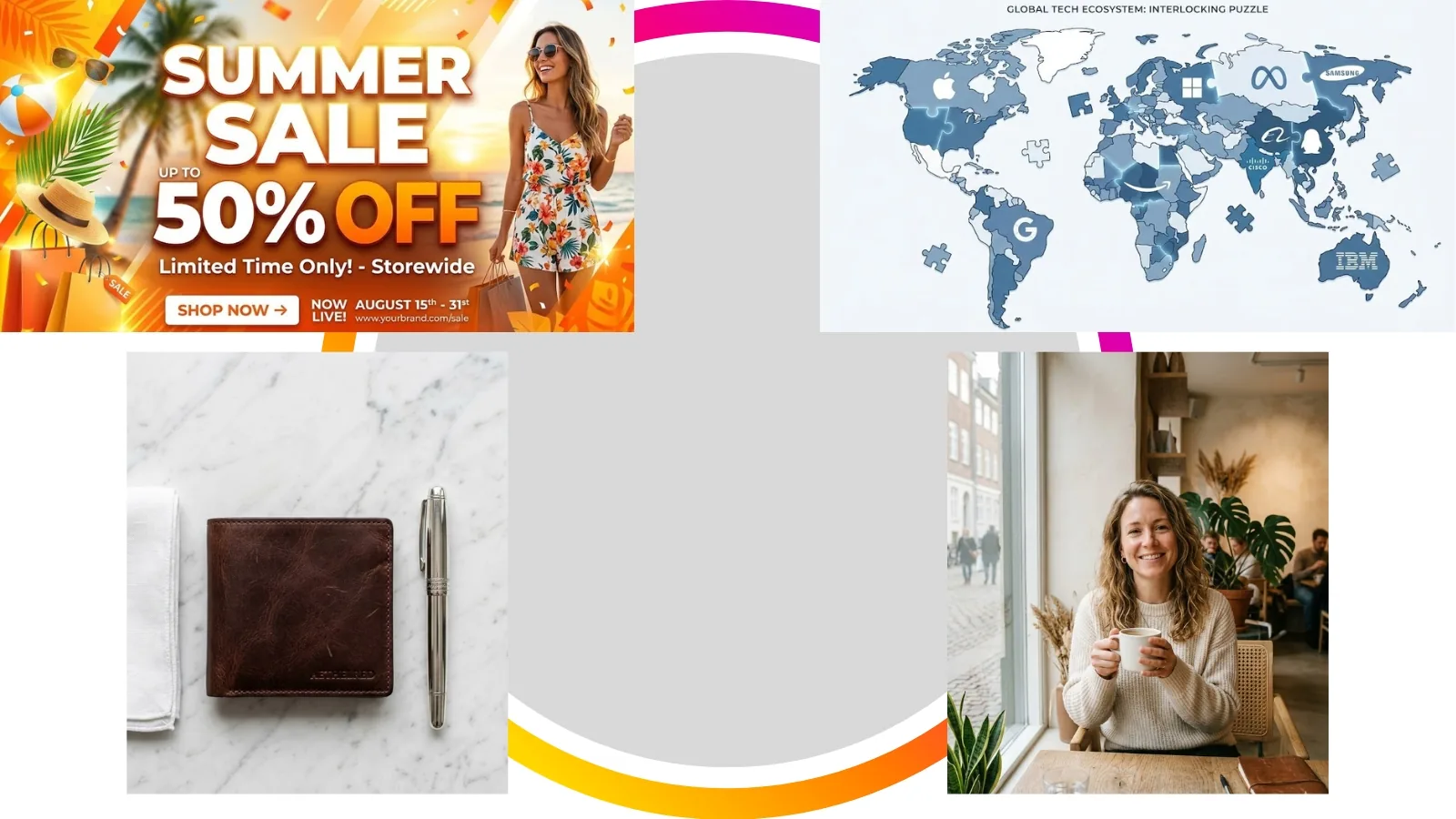
Each use case below maps a real content creator or designer workflow to a specific Nano Banana 2 capability - with a sample prompt you can adapt directly.
1. Social Media Content at Scale
Who it's for: Social media managers, influencers, brand accounts producing daily visual content.
What Nano Banana 2 adds: Flash-speed generation means social-ready images can be produced and iterated in the time a brief previously took to write. Character consistency across images maintains brand identity across a content series without manual reference management.
2. Marketing Mockups with Legible Text
Who it's for: Graphic designers, marketing teams, freelancers producing ad mockups and promotional visuals.
What Nano Banana 2 adds: Precision text rendering is the feature that makes this use case viable in a way earlier AI image models were not. Previous models consistently produced garbled, illegible, or randomly combined letters when text was requested inside an image. Nano Banana 2 generates accurate, stylistically correct text for banners, posters, and cards.
3. Multilingual Content and Ad Localization
Who it's for: International brands, global marketing teams, content creators targeting multiple language markets.
What Nano Banana 2 adds: In-image text translation and localization - the model can generate or translate text within an image while simultaneously understanding and adapting the visual elements to match regional context. This removes the manual step of exporting, editing in a design tool, and re-rendering for each market.
4. Character-Consistent Storyboarding and Comics
Who it's for: Illustrators, comic artists, brand storytellers, video pre-production teams.
What Nano Banana 2 adds: Character consistency across up to five characters in a single workflow eliminates the primary technical obstacle that made AI-assisted sequential art impractical - the model's tendency to produce slightly different versions of the same character in each frame. With Nano Banana 2, a single character defined in one image can be maintained consistently across a story arc.
5. Product Photography and E-commerce Visuals
Who it's for: E-commerce sellers, product designers, brand managers producing catalog imagery.
What Nano Banana 2 adds: Improved texture rendering and vibrant lighting produce product images that match studio photography quality for most standard product types. Combined with object fidelity for up to 14 objects, complex flat-lay compositions with multiple products and props can be generated without losing the identifiable details of each element.
6. Infographics and Data Visualizations
Who it's for: Content marketers, educators, researchers, journalists producing explanatory visual content.
What Nano Banana 2 adds: Advanced world knowledge from Gemini's knowledge base, combined with precise instruction following, makes Nano Banana 2 capable of generating structurally meaningful infographics - not just decorative diagrams. You can describe a data relationship or process flow and receive a visually organized chart or diagram rather than a stylistically random visual.
7. Current-Event and News-Referenced Imagery
Who it's for: Editorial designers, journalists, bloggers, and content producers working with timely topics.
What Nano Banana 2 adds: Real-time web grounding is uniquely useful here. Standard AI image models can only render subjects they encountered during training - anything that happened after the training cutoff is rendered inaccurately or not at all. Nano Banana 2's live web search integration allows it to generate contextually accurate imagery for recent events, current news figures, and newly released products without the training data lag.
Frequently Asked Questions
Is Nano Banana 2 free to use?
Yes. Nano Banana 2 is the default image generation model for all Gemini users at no cost - it replaces Nano Banana Pro across the Free, Fast, Thinking, and Pro tiers of the Gemini app. Google AI Pro and Ultra subscribers retain access to the original Nano Banana Pro through the three-dot menu when they need specialized high-fidelity outputs. For developers, access via the Gemini API and AI Studio requires a paid API key, with pricing published in Google AI Studio.
What is the difference between Nano Banana 2 and Nano Banana Pro?
Nano Banana 2 is built on Gemini 3.1 Flash - optimized for speed, real-time web grounding, and precise instruction following, with 4K output and extended aspect ratios. Nano Banana Pro is built on Gemini 3 Pro - slower, but with maximum factual accuracy for specialized high-fidelity tasks. For most content creation workflows, Nano Banana 2 is the appropriate tool. Nano Banana Pro remains relevant for tasks where rendering accuracy on a specific known subject is the primary requirement and speed is secondary.
Can Nano Banana 2 generate accurate text inside images?
Yes - this is one of the model's explicitly improved capabilities. Nano Banana 2 generates legible, accurately spelled text within images for marketing mockups, greeting cards, posters, and banners. It also supports in-image text translation, meaning it can take an existing image with text and re-render the text in a different language while preserving the visual style. Previous AI image models including the original Nano Banana consistently produced garbled, inconsistent, or non-existent readable text - this has been substantially corrected in Nano Banana 2.
Are AI-generated images from Nano Banana 2 usable for commercial purposes?
Google's current terms allow commercial use of images generated through Nano Banana 2. All outputs carry an invisible SynthID digital watermark combined with C2PA Content Credentials, which embed verifiable provenance data in the file - any tool supporting C2PA can confirm the image was AI-generated and identify its origin. This transparency layer is increasingly relevant for compliance in advertising and editorial contexts. Check Google's current terms of service for specific commercial licensing conditions, as these may be updated.
How do I access Nano Banana 2 in the Gemini app?
Open the Gemini app on iOS, Android, or web. Select "Create images" from the tools menu - Nano Banana 2 is now the default model, so no additional configuration is required. You can choose between Fast, Thinking, and Pro modes from the model selector. For more complex prompts that need higher reasoning quality, Thinking mode activates the configurable thinking levels that allow the model to reason through nuanced instructions before generating. Google AI Pro and Ultra subscribers can switch to Nano Banana Pro by generating an image and selecting "Redo with Pro" from the three-dot menu.
The Future of AI Image Generation
Nano Banana 2's launch marks a specific inflection point: the moment when AI image generation capability stopped being a paid-subscriber differentiator and became a baseline feature available to all users of a major platform. When a model that six months ago required a Pro subscription is now the free default, the pace of adoption across content creation workflows accelerates significantly.
Three Directions to Watch
Real-time generation: Flash architecture is a step toward generation speeds that feel instantaneous during iteration. The next development is sub-second generation - not in response to a submitted prompt, but as you type, in real time. This changes the interaction model from "request and review" to "generate while you think."
Video as the next frontier: Still image generation is approaching solved-problem status for most commercial use cases. The remaining gap - video generation with temporal consistency, no flickering, and accurate motion rendering - is the active development frontier for every major AI lab. Nano Banana's integration into Flow (Google's video tool) signals that the Nano Banana model family will be extended to video generation directly.
Convergence of creation and distribution: Nano Banana 2 is already integrated into Google Search, Google Ads, and Google Lens - not just a standalone generation tool. The direction this points toward is AI image generation embedded directly inside the distribution channel: a social platform that generates visual content as you compose the post, an ad platform that generates creative at the moment of audience targeting. The separation between "make the image" and "publish the image" will narrow.
For content creators and designers working today, the practical implication is straightforward: the tools available now - 4K output, character consistency, real-time web grounding, precise text rendering - already exceed what was possible with professional studio workflows for a significant range of content types. The value of Nano Banana 2 is not in its technical specifications; it is in removing the remaining friction between an idea and a finished, publication-ready image.